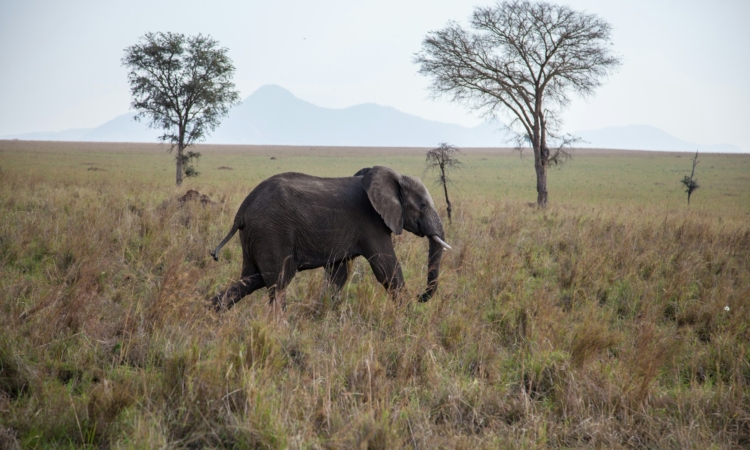

Murchison Falls National Park is home to a large number of elephants, with about 1,300 to 1,500 individuals living in the Savannah grasslands, woodlands, and riverine forests. These habitats provide the elephants with enough food and shelter for their survival.
The species found in the park is the African Savannah elephant. These are the largest land animals on Earth, weighing around 6,000 kilograms. Elephants are herbivores and feed on a variety of plants including grass, leaves, bark, fruits, and roots. One elephant can eat up to 300 kilograms of vegetation each day.

One of the most interesting things about elephants is their social life. They live in matriarchal herds led by an older, experienced female. These groups are usually made up of females and their young, while adult males live alone or form small groups when they reach maturity. Elephants are deeply bonded and often show emotions. They are even known to mourn their dead.
Elephant reproduction is slow and complex. Females carry their babies for about 22 months, nearly two years. A newborn elephant is called a calf. Shortly after birth, it can stand and walk.
Other females in the herd often help the mother during birth and also take part in caring for the newborn. A calf usually weighs between 100 and 140 kilograms at birth. It depends fully on its mother for food and protection during its early years.
Because of the long gestation period, elephants have a low birth rate. A female gives birth to one calf every four to five years.
In Murchison Falls National Park, elephants are often seen in the Nile-Lake Albert Delta area, which has plenty of vegetation and water. They are also frequently spotted along the Buligi Game Track.
Despite their strong presence in the park, elephants face serious threats. These include poaching driven by the ivory trade, human-wildlife conflict due to the expansion of nearby communities, and loss of habitat from deforestation and infrastructure development.
To help protect the elephants, the Uganda Wildlife Authority, together with the African Wildlife Foundation, has introduced anti-poaching patrols, monitors elephant populations, and works with local communities to support conservation. These efforts have helped to protect and grow the elephant population in the park.
Elephants are one of the most important wildlife species in Murchison Falls National Park. They play a big role in supporting the park’s natural environment.